
- ESX 3.x or ESX 4.x VMkernel logs contain these messages:
SCSI: vm 1043: 5522: Sync CR at 64
SCSI: vm 1043: 5522: Sync CR at 48
SCSI: vm 1043: 5522: Sync CR at 32
SCSI: vm 1043: 5522: Sync CR at 16
SCSI: vm 1043: 5522: Sync CR at 0
WARNING: SCSI: 5532: Failing I/O due to too many reservation conflicts
WARNING: SCSI: 5628: status SCSI reservation conflict, rstatus 0xc0de01 for vmhba1:0:7. residual R 919, CR 0, ER 3
WARNING: J3: 1970: Error committing txn to slot 0: SCSI reservation conflict - ESXi 4.x, ESXi 5.x and ESXi 6.0 vmkernel logs contains below messages
Vendor: EMC Model: SYMMETRIX Rev: 5771
Type: Direct-Access ANSI SCSI revision: 03
scsi0 (0,0,52) : RESERVATION CONFLICT
scsi0 (0,0,52) : RESERVATION CONFLICT
scsi0 (0,0,52) : RESERVATION CONFLICT
scsi0 (0,0,52) : RESERVATION CONFLICT
scsi0 (0,0,52) : RESERVATION CONFLICT
scsi0 (0,0,52) : RESERVATION CONFLICT
sdh : READ CAPACITY failed.
status = c, message = 00, host = 0, driver = 00
scsi0 (0,0,52) : RESERVATION CONFLICT
scsi0 (0,0,52) : RESERVATION CONFLICT
scsi0 (0,0,52) : RESERVATION CONFLICT
VMWARE: Device that would have been attached as scsi disk sdh at scsi0,channel 0, id 0, lun 52 Has not been attached because this path could not complete a READ command eventhough a TUR worked.result = 0x18 key = 0x0, asc = 0x0, ascq = 0x0
VMWARE: Device that would have been attached as scsi disk sdh at scsi0,channel 0, id 0, lun 52 Has not been attached because it is a duplicate path or on a passive path
scan_scsis starting finish
scan_scsis done with finish
Features | Documentation | Knowledge Base | Discussion Forums
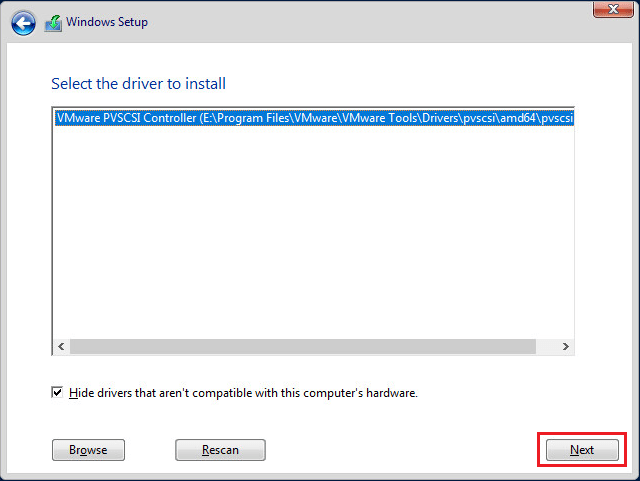
Therefore, if you added SCSI Controller 1 when creating a SCSI controller, you should select it. For example, if you have a new address SCSI(1:0) on VM (node1) for a new disk (this means the first disk on the second SCSI controller), you should use the same address SCSI(1:0) for the shared disk on the second VM (node2). It is important! Since the Windows ISO does not include a driver for the VMware Paravirtual SCSI (PVSCSI) adapter. Add a Floppy Drive and select the driver file from the C:Program Files (x86)VMwareVMware WorkstationResources.flp folder on the Windows host. If you are running a Windows virtual machine on a Linux host, the driver is saved in the /usr/lib/vmware/resources folder by default. Provides Windows driver for full featured (MR) and entry level (iMR) 12Gbs Intel RAID Controllers. Driver: Windows 10. Windows 8.1. Windows 8. 4 more: 6.714.18.00 Latest: 9/13/2019: Windows. Driver for Intel® RAID Module RMSP3AD160F, RMSP3CD080F, RMSP3HD080E and Intel® RAID Adapter RSP3TD160F, RSP3MD088F, RSP3DD080F, RSP3WD080E. Toshiba virtual device scsi processor device my toshiba qosmio g30 194 cannot find the driver for a device named 'toshiba virtual device scsi processor device'. To access boot disk devices attached to a vmware paravirtual scsi controller, verify that the virtual machine has a windows 2003 or windows 2008 guest operating system. Enabling SCSIID on VMware. To preserve the device names across reboots in Linux, udev rules is the recommended option. The idea is to extract SCSI device’s unique ID and assign it to a symbolic name that will persist across reboots.
The following sections describe how to use generic SCSI devices in a virtual machine:
- Generic SCSI on a Windows Host Operating System
- Generic SCSI on a Linux Host Operating System
Generic SCSI lets a virtual machine run any SCSI device that is supported by the guest operating system in the virtual machine. Generic SCSI gives the guest operating system direct access to SCSI devices connected to the host, such as scanners and tape drives.

Using the SCSI Generic driver in Windows, VMware Workstation allows your guest operating system to operate generic SCSI devices — including scanners, tape drives and other data storage devices — in a virtual machine.
Note: In order to access host SCSI devices as Generic SCSI devices from within a virtual machine, you must run VMware Workstation as a user with administrator access.
In theory, generic SCSI is completely device independent, but VMware has discovered it is sensitive to the guest operating system, device class and specific SCSI hardware. We encourage you to try any SCSI hardware you want to use and report problems to VMware technical support.

Note: If you are using generic SCSI devices in a Windows 95, Windows 98 or Windows Me guest operating system and are experiencing problems with the devices, download the latest Mylex® (BusLogic) BT/KT-958 compatible host bus adapter from www.lsilogic.com. This driver overrides what Windows chooses as the best driver, but it corrects known problems.
To use SCSI devices in a Windows XP or Windows Server 2003 virtual machine, you need a special SCSI driver available from the download section of the VMware Web site at www.vmware.com/download. Follow the instructions on the Web site to install the driver.
Generic SCSI devices use the virtual Mylex (BusLogic) BT/KT-958 compatible host bus adapter provided by the virtual machine. Some guest operating systems guide you through installing the drivers after you install the first SCSI device in the virtual machine. On Windows NT 4.0, however, you may need to install the driver manually, if it is not already installed for a virtual SCSI disk. You should do so before you add a generic SCSI device.
To install the BusLogic driver in a Windows NT 4.0 guest, have your Windows NT installation CD available and follow these steps.
- Open the SCSI Adapters control panel.
Start > Settings > Control Panel > SCSI Adapters
- Click the Drivers tab.
- Click Add.
- In the list of vendors on the left, select BusLogic.
- In the list of drivers on the right, select BusLogic MultiMaster PCI SCSI Host Adapters.
- Click OK.
- Insert the Windows NT CD when you are prompted. Click OK.
- Reboot when you are prompted.
You can add generic SCSI devices to your virtual machine in the virtual machine settings editor. When you set up a generic SCSI device, the virtual machine must be powered off.
- If it is not already running, launch VMware Workstation.
Start > Programs > VMware > VMware Workstation
- Open the virtual machine in which you want to use the generic SCSI device. Make sure the virtual machine is powered off.
- From the VMware Workstation window, choose VM > Settings. The virtual machine settings editor opens.
- Click Add to start the Add Hardware Wizard. Click Next.
- Select Generic SCSI Device, then click Next.
- Choose the name of the physical device you want to use.
Then choose the virtual device node where you want this device to appear in the virtual machine.
A check box under Device status allows you to specify whether the device should be connected each time the virtual machine is powered on.
- Click Finish to install the new device.
- Click OK to save the configuration and close the virtual machine settings editor.
To remove this device, launch the virtual machine settings editor, select the generic SCSI device, then click Remove.
Using the SCSI Generic driver in Linux, VMware Workstation allows your guest operating system to operate generic SCSI devices within a virtual machine. The SCSI Generic driver sets up a mapping for each SCSI device in /dev. Each entry starts with sg (for the SCSI Generic driver) followed by a letter. For example, /dev/sga is the first generic SCSI device.
Each entry corresponds to a SCSI device, in the order specified in
/proc/scsi/scsi, from the lowest device ID on the lowest adapter to the highest device ID on the lowest adapter, and so on to the highest device ID on the highest adapter. Do not enter /dev/st0 or /dev/scd0.
Vmware Scsi & Raid Devices Driver Download For Windows 10 32-bit
Note: When setting up a generic SCSI device in the virtual machine settings editor, as described later in this section, you specify the device you wish to install in the virtual machine by typing its /dev/sg entry in the Connection field. You must be logged on as a user who has permissions to use the device.
Generic SCSI requires version 2.1.36 of the SCSI Generic (sg.o) driver, which comes with kernel 2.2.14 and higher.
Under Linux some devices — specifically tape drives, disk drives and CD-ROM drives — already have a designated /dev entry (traditionally, st, sd and scd, respectively). When the SCSI Generic driver is installed, Linux also identifies these devices with corresponding sg entries in /dev — in addition to their traditional entries. VMware Workstation ensures that multiple programs are not using the same /dev/sg entry at the same time but cannot always ensure that multiple programs are not using the /dev/sg and the traditional /dev entry at the same time. It is important that you do not attempt to use the same device in both host and guest. This can cause unexpected behavior and may cause loss or corruption of data.
Vmware Scsi & Raid Devices Driver Download For Windows 10 64-bit
You must have read and write permissions on a given generic SCSI device in order to use the device within a virtual machine, even if the device is a read-only device such as a CD-ROM drive. These devices typically default to root-only permissions. Your administrator should create a group with access to read and write to these devices, then add the appropriate users to that group.
In theory, generic SCSI is completely device independent, but VMware has discovered it is sensitive to the guest operating system, device class and specific SCSI hardware. We encourage you to try any SCSI hardware you want to use and report problems to VMware technical support.
Note: If you are using generic SCSI devices in a Windows 95, Windows 98 or Windows Me guest operating system and are experiencing problems with the devices, download the latest Mylex (BusLogic) BT/KT-958 compatible host bus adapter from www.lsilogic.com. This driver overrides what Windows chooses as the best driver, but it corrects known problems. To use SCSI devices in a Windows XP or Windows Server 2003 virtual machine, you need a special SCSI driver available from the download section of the VMware Web site at www.vmware.com/download.
You can add generic SCSI devices to your virtual machine in the virtual machine settings editor. The virtual machine settings editor lets you map virtual SCSI devices to physical generic SCSI devices on the host.
Vmware Scsi & Raid Devices Driver Download For Windows 10 Xp
When you set up a generic SCSI device, the virtual machine must be powered off.
Vmware Scsi & Raid Devices Driver Download For Windows 10 Download
- Launch VMware Workstation and select the virtual machine. Make sure the virtual machine is powered off.
- Choose VM > Settings. The virtual machine settings editor opens.
- Click Add to start the Add Hardware Wizard. Select Generic SCSI Device, then click Next.
- Choose the name of the physical device you want to use.
Then choose the virtual device node where you want this device to appear in the virtual machine.
A check box under Device status allows you to specify whether the device should be connected each time the virtual machine is powered on.
- Click Finish to install the new device.
- Click OK to save the configuration and close the virtual machine settings editor.
Vmware SCSI & RAID Devices Driver Download For Windows 10
To remove this device, launch the virtual machine settings editor, select the generic SCSI device, then click Remove.